
Search

Corporate sustainability

How we approach sustainability

At Quilter, we have divided our approach to sustainability and our impact on climate change into two key pillars that capture our operations and our investment activities.

  • Corporate sustainability - Corporate sustainability is managed centrally at the Group level. This reflects the practical reality of how our business operates: our segments share office space, facilities, and resources, making a unified approach to operational sustainability both efficient and effective. Our focus here is on reducing the environmental footprint of our own operations, including our upstream supply chain.
  • Responsible investment - Quilter plc has a Group-level objective to be a responsible investor, guided by three thematic priorities: climate change, human rights, and natural capital. These themes shape our engagement activity and inform how we assess sustainability risks and opportunities across our investment offerings. Our two business segments, Affluent and High Net Worth (“HNW”), have distinct investment processes, product offerings, and customer bases. As a result, each segment has developed its own tailored approach to responsible investment and climate change. While both segments incorporate customers’ responsible investment preferences, apply environmental, social and governance (“ESG”) factor integration, and practise active ownership through engagement and voting, they implement these elements in ways that reflect their differing investment processes, operational models, and customer needs.

Quilter’s climate reporting

Quilter is committed to transparent sustainability disclosures, and we publish a Group TCFD Report which provides detailed information about how we monitor our climate-related risks and opportunities for our operations and investment activities. In this report we also provide a detailed breakdown of our operational and financed emissions and the progress we are making towards our operational emissions target.

We are also signatories to the UN Global Compact and respond to the annual CDP (formerly the Carbon Disclosure Project) questionnaire – providing our stakeholders with clear and transparent data on our climate impact.

Read the TCFD report

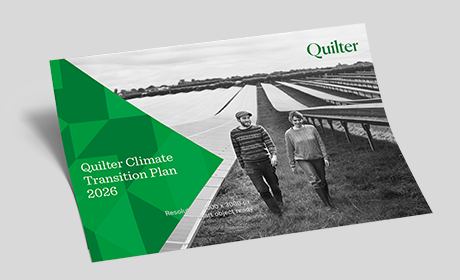
Quilter’s Climate Transition Plan

Quilter is committed to playing its part in the global effort to combat climate change. This Climate Transition Plan sets out the steps we will take to transition to a net zero business by 2050, in line with the goals of the Paris Agreement and the UK’s legal commitment to achieving net zero greenhouse gas (“GHG”) emissions.

In 2026, we published the first iteration of our Climate Transition Plan, which focuses on the actions we will take between now and 2030 to reduce our carbon footprint and lay the foundations for long-term decarbonisation. While we support the principle that companies should have a clear roadmap to net zero by 2050, we acknowledge that a 25-year planning horizon involves a high degree of uncertainty in terms of climate, economic, political, and social factors that may impact our actions. As such, this initial plan prioritises near-term actions that we can implement, monitor, and report against transparently.

To reflect this approach, our plan is structured around two distinct time horizons:

  • Short-term actions, commitments, and targets (2025–2030): Specific steps we will take to reduce emissions and build resilience; and
  • Longer-term actions (post-2030): Areas we intend to explore and develop further, without committing to specific timelines at this stage

We will publish an updated transition plan before 2030, which will outline our next phase of actions and provide greater clarity on our longer-term pathway to net zero.


Read the climate transition plan

Reducing our operational emissions

We have set a target to reduce our operational emissions (covering Scope 1 and 2 emissions) by 80% by 2030. This target forms part of the long-term incentive plan for our executive directors.

Our Scope 1 and 2 emissions in 2025 were 79% lower than our 2020 baseline showing good progress towards our target. The main driver of this reduction was our smaller office footprint in response to changing workspace needs and our efforts to transition to renewable electricity sources at our offices.  In the future, we expect to keep reducing our emissions gradually year on year towards our goal.

Our  in recent years has been on improving the accuracy, reliability and consistency of our carbon footprint data. This has allowed us to better understand the most significant sources of our emissions, identify opportunities to reduce emissions and has laid the foundation for our Climate Transition Plan.

We also engaged our energy broker to provide an Energy Savings and Opportunities Scheme Report and Energy Audit to identify opportunities in our Southampton office to improve our energy efficiency and reduce consumption.

For more information, please see the Quilter TCFD Report.

Responsible investment

In 2025, our Affluent and High Net Worth segments published the first iterations of their Climate Action Plans (“CAP”), outlining short-term priorities and key milestones for addressing climate change in relation to the investments they manage on behalf of customers.

For more information about how we approach Responsible Investment at Quilter, please visit:

Responsible Investment | Quilter Cheviot

Responsible investment | Quilter